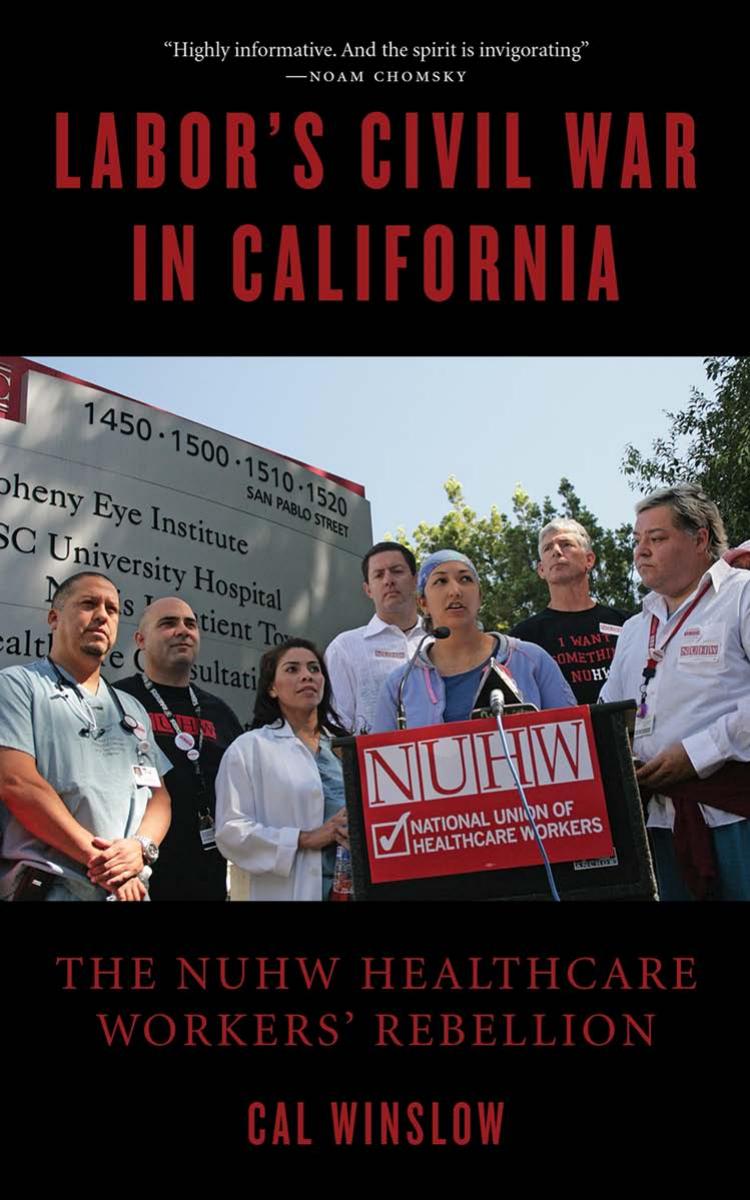
Labor's Civil War in California: The NUHW Healthcare Workers' Rebellion by Cal Winslow
Author:Cal Winslow [Winslow, Cal]
Language: eng
Format: epub, pdf
Tags: Law, Labor & Employment
ISBN: 9781458775412
Google: d-cu1BO61AsC
Publisher: ReadHowYouWant.com
Published: 2010-07-15T10:33:09+00:00
CHAPTER SEVEN
âWe Can Get Involvedâ
Perhaps more than any other union, SEIU has made a principle of centralized, top-down decision making. It has maligned membership rights and the election of representatives; it has belittled the idea of workersâ participation, in theory as well as practice. In its centralism, âone voice,â the SEIU leadership substitutes itself for the membership, in its âone strategyâ it implicitly substitutes itself for the entire labor movement if not the working class. Oblivious to the history of the movementâs unpredictably, its spontaneity, SEIUâs perspectives are mechanical in the extreme.
Unfortunately, there are others in the labor movement who share these views, but few with the shamelessness of Stern and his regime. And SEIU, alas, has its supporters, including in the universities and amongst the âexpertsâ who staff the countryâs academic labor centers, a small chorus of academics who cheer SEIU on.[96]
In the years of Sternâs ascent, it has been common, in seminars and on the agendas of academic conferences, to see listed speakers and panels debating the topic âunion democracy.â The 1999 Yale conference, hosted by Scholars, Artists and Writers for Social Justice (SAWSJ), featured such a session; the question was debated, pro or con, âAre democratic unions the best way to mobilize militant workers?â This panel addressed this â controversial question from the perspective of labor historians, union organizers and democratic theorists.â Stern, while not on this panel, was a keynote speaker at the conference.[97]
The debate, ten years on, still with SEIU at the center, has undermined fundamental beliefs, including what ought to be the self-evident notion of the indispensability of democracy within the workersâ movement. Historian Steve Fraser once cynically suggested that union democracy was a non-issue, a fetish of an insignificant Left, when not a weapon of the Right. He added, approvingly: âmany labor leaders secretly believe and practice what one of them openly confessed back in the 1920s: âAs a democracy no union would last six months.ââ[98] This has taken its toll on the movementâas has the SEIU checkbook; rare is the labor center, publication or project that is not in debt to Stern, one way or another. Nevertheless, this will change; it has already. This past summer, hundreds of academics, most still unwilling to support NUHW, signed a letter condemning SEIU raids on UNITE HERE. Stanley Aronowitz replied to Fraser in the â90s debate and his answer still stands: âWhen unions deprive the rank-and-file of choice, when leaders favor mobilization but not participation, they succeed only in driving a deeper nail in laborâs coffin.â[99]
SEIU nationally was not the scene of â60s and â70s movements, but it moved center-stage in 1995; its President John Sweeney led the âNew Voiceâ team that successfully forced Lane Kirkland, President of the AFL-CIO, to step down, then defeated his nominee, Secretary-Treasurer Thomas Donahue. Sweeneyâs election was highly unusual in U.S. labor history: seldom are incumbent administrations replaced. This was an important achievement but one with few memorable results. But one should be acknowledged. Sweeneyâs election was greatly helped
Download
Labor's Civil War in California: The NUHW Healthcare Workers' Rebellion by Cal Winslow.pdf
This site does not store any files on its server. We only index and link to content provided by other sites. Please contact the content providers to delete copyright contents if any and email us, we'll remove relevant links or contents immediately.
The Secret History by Donna Tartt(19086)
The Social Justice Warrior Handbook by Lisa De Pasquale(12190)
Thirteen Reasons Why by Jay Asher(8909)
This Is How You Lose Her by Junot Diaz(6886)
Weapons of Math Destruction by Cathy O'Neil(6279)
Zero to One by Peter Thiel(5801)
Beartown by Fredrik Backman(5754)
The Myth of the Strong Leader by Archie Brown(5507)
The Fire Next Time by James Baldwin(5442)
How Democracies Die by Steven Levitsky & Daniel Ziblatt(5218)
Promise Me, Dad by Joe Biden(5153)
Stone's Rules by Roger Stone(5087)
A Higher Loyalty: Truth, Lies, and Leadership by James Comey(4961)
100 Deadly Skills by Clint Emerson(4925)
Rise and Kill First by Ronen Bergman(4788)
Secrecy World by Jake Bernstein(4753)
The David Icke Guide to the Global Conspiracy (and how to end it) by David Icke(4717)
The Farm by Tom Rob Smith(4507)
The Doomsday Machine by Daniel Ellsberg(4490)
